
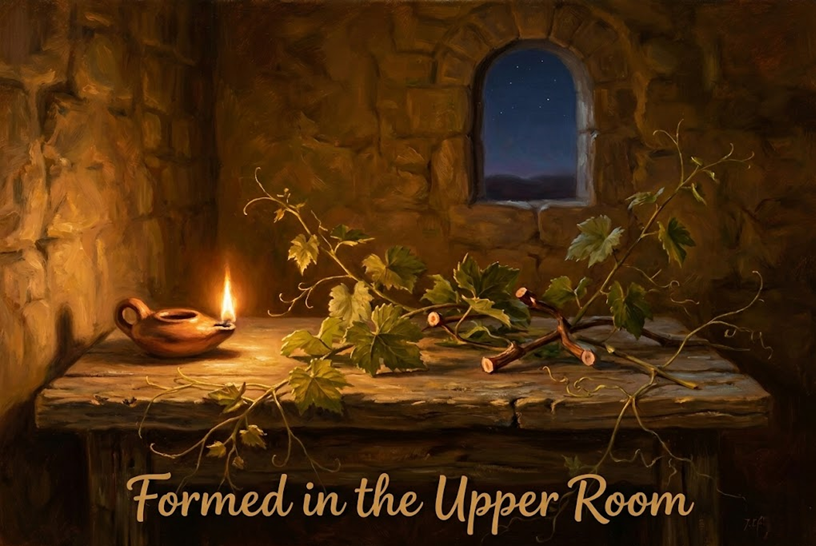
[Note: This is Part 1 of “Formed in the Upper Room”, a 5-part series examining discipleship from John 13-16.]
Most discipleship conversations begin with what disciples do. Attend. Serve. Study. Obey. We reach naturally for the checklist, the commitment, the next thing that will finally get our spiritual lives into better shape. Jesus starts somewhere else entirely. He starts with a vine.
The night before his crucifixion, he gathered his disciples in an upper room in Jerusalem. He knew what was coming. They didn’t — not really. And with one evening left to say what mattered most about following him, he didn’t hand them a set of instructions. He told them what it looks like to abide in Christ. What that phrase actually means, and why it is the foundation for everything else in discipleship, is what John 15:1-11 is about.
A Night Unlike Any Other
To read John 13-16 without feeling the weight of the setting is to miss something essential. These chapters record what is commonly called the Upper Room Discourse — Jesus’ final extended conversation with his disciples before his arrest, trial, and death. He has already washed their feet. He has told them that one of them will betray him. Judas has left the room. The shadow of the cross is not distant; it is hours away.
This is not calm theology delivered at a safe distance. It is urgent pastoral formation. Jesus is talking to men who are about to have their world collapse — who will, before the night is over, fall asleep when he needs them most, deny him three times, and scatter into the dark. He speaks the way a father speaks when time is short and what matters most must be said plainly.
This series — “Formed in the Upper Room” — will follow that conversation through John 13-16. We will look at what it means to remain in Christ (this post), how that remaining takes the shape of love (Post 2), why the Holy Spirit is the one who makes any of it possible (Posts 3 and 4), and where this formation sends us (Post 5). Jesus is not simply imparting information in these chapters. He is forming disciples in the hours when formation mattered most. We would do well to let him form us too.
The Vine and the Branches
“I am the true vine, and my Father is the vinedresser. Every branch in me that does not bear fruit he takes away, and every branch that does bear fruit he prunes, that it may bear more fruit. Already you are clean because of the word that I have spoken to you. Abide in me, and I in you. As the branch cannot bear fruit by itself, unless it abides in the vine, neither can you, unless you abide in me. I am the vine; you are the branches. Whoever abides in me and I in him, he it is that bears much fruit, for apart from me you can do nothing. If anyone does not abide in me he is thrown away like a branch and withers; and the branches are gathered, thrown into the fire, and burned. If you abide in me, and my words abide in you, ask whatever you wish, and it will be done for you. By this my Father is glorified, that you bear much fruit and so prove to be my disciples. As the Father has loved me, so have I loved you. Abide in my love. If you keep my commandments, you will abide in my love, just as I have kept my Father’s commandments and abide in his love. These things I have spoken to you, that my joy may be in you, and that your joy may be full.” (John 15:1-11)
“I am the true vine.” In John’s Gospel, this is the seventh of Jesus’ great “I am” declarations — statements that claim for Jesus the name, identity, and character of God himself. Each one carries theological weight. But this one is structural. Jesus is not saying he resembles a vine or that he serves a similar function. He is establishing what kind of relationship exists between himself and his disciples.
The image was agricultural, and every person in that room understood it without explanation. A vine does not inspire its branches to produce fruit by setting a good example. It supplies life. Branches do not generate fruit; they bear fruit, and only because the vine’s life is actually flowing through them. Cut a branch and it does not produce less fruit. It produces none at all. The capacity for fruitfulness was never the branch’s to begin with.
What It Means to Abide in Christ
“Abide in me, and I in you.” The Greek verb is meno — to remain, to stay, to make your dwelling. Jesus uses it ten times in this passage alone. He is not describing a spiritual technique. He is describing where you live.
To abide in Christ is to locate yourself daily in his finished work rather than in your spiritual performance. It means returning to him when you drift — not because you have earned your way back, but because the vine is still there and its life is still available to you. It means bringing your actual life to God in prayer rather than the polished version you think you ought to be presenting. It means reading his words not as a religious obligation to complete but as the living speech of the one in whom you are supposed to be dwelling.
Notice the mutuality Jesus describes: “Abide in me, and I in you.” This is not a one-directional reach toward a distant Christ. The life flows both ways. The branch abides in the vine; the vine’s life abides in the branch. This is precisely what makes verse seven possible: “If you abide in me, and my words abide in you, ask whatever you wish, and it will be done for you.” The praying that the vine honors is not the praying of an ambitious branch straining to produce something. It is the praying of a branch that has made its home in the vine and whose desires are being shaped by the one who gives life.
Abiding is not passive. Jesus is describing an active posture, a choice made again and again. But it is not strenuous in the way we usually imagine. It looks less like climbing and more like returning. People who are genuinely abiding often do not feel particularly spiritual. They simply keep coming back.
Apart from Me You Can Do Nothing
“Apart from me you can do nothing.” This line tends to register as a warning, and it has that edge. But consider what it actually gives us.
If the problem with our discipleship is disconnection from the vine, then the solution is not to try harder as a branch. It is to stay connected. The weight does not fall on us to produce; it falls on us to remain. And Jesus does not say “apart from me you will bear less” or “apart from me you will struggle.” He says nothing. The language is stark, and it is exactly right.
The disciples in that room were about to discover this in the most painful way. Before morning, every human commitment they had made would fail. Peter would deny him three times. The rest would scatter. Not because they didn’t love Jesus — they did. But no quantity of sincere intention is sufficient when you are living apart from the vine. This is not a failure of will. It is a description of what branches are.
Paul names the same reality from a different angle in Galatians 5. The fruit of the Spirit — love, joy, peace, patience, kindness, goodness, faithfulness, gentleness, self-control — these are not spiritual achievements. Paul’s grammar is instructive: he calls it the fruit of the Spirit, not the fruit of discipline or effort. It grows. It is the natural result of life in the Spirit, of genuine connection to the risen Christ. A branch that is truly abiding does not manufacture these things. They appear.
The Father is glorified, Jesus says, when we bear much fruit. The connection matters. Fruit does not glorify God because disciples worked hard to produce it. It glorifies God because it shows that something is alive — that the vine’s life is genuinely flowing through branches like us. The visible dependence is the point.
There is also a word here about pruning that deserves a moment. Jesus says the Father “prunes every branch that bears fruit, that it may bear more fruit” (John 15:2). This is often spiritualized past its actual sting. Pruning is cutting. It removes what seemed to be alive. There are seasons in the Christian life that feel like reduction — stripped of comforts you counted on, limited in ways you didn’t choose, disappointed in things you thought God had promised. Those seasons may be precisely what the Vinedresser is doing. The branch does not need to understand the pruning. It needs to remain.
Application Points
- Make abiding your daily orientation, not a special spiritual exercise. Abiding is not an activity alongside prayer and Bible reading. It is the posture from which you do everything else. Begin the day by locating yourself in who Christ is and what he has done — not in how you performed yesterday or what you still need to accomplish.
- Pray as someone who actually lives in the vine. Jesus ties prayer directly to abiding: “If you abide in me, and my words abide in you, ask whatever you wish” (John 15:7). The prayer that flows from abiding is honest and specific, not a performance for God but a conversation with the one in whom you are dwelling. Bring what is actually real.
- Read Scripture as the vine’s voice. “If my words abide in you” — Jesus connects his words to the abiding life. The Bible is not merely a resource for your spiritual development. It is the primary way the vine speaks to the branch, keeping it oriented to reality. Attentive, expectant reading of Scripture is itself a form of staying.
- Notice when you are striving rather than remaining. There is a recognizable feeling to disconnected discipleship — driven, measuring, tracking output, comparing performance, feeling the pressure to produce something visible. When you notice that quality in yourself, it is usually a signal not to try harder but to return. Abiding is not an achievement. It is a homecoming.
- Receive the pruning without interpreting it as abandonment. Not every difficult season is discipline for sin. Some of it is the Vinedresser working on a branch that is already bearing fruit, removing what would limit future fruitfulness. The branch does not choose its pruning. It chooses to remain.
Reflection Questions
- What substitutes for abiding in Christ have you been relying on — spiritual activity, visible achievement, comparison with others? What does your reliance on those substitutes reveal about what you actually believe about how discipleship works?
- Where do you most need to return to the vine this week — not through more effort, but through honest dependence on Christ?
In the next post, we will look at the first and most visible fruit of abiding: the love that Jesus both commands and provides, and that he says will be the mark by which the watching world recognizes his disciples.