
How to Study the Bible: Building Biblical Literacy
Building Biblical Literacy for Faithful Discipleship
The Bible is God’s Word—inspired, authoritative, and sufficient for life and godliness (2 Timothy 3:16-17, 2 Peter 1:3). But the Bible is also a library of diverse books written in ancient languages, in specific historical contexts, using various literary forms. To read it faithfully, we need to read it on its own terms.
Biblical literacy means more than knowing isolated verses or favorite passages. It means learning to understand Scripture in context, trace themes through biblical books, recognize different genres, and see how the whole Bible tells one unified story that points to Christ.
This page provides foundational principles to help you study God’s Word more faithfully and grow in your understanding.
Why Biblical Literacy Matters
1. God Speaks Through His Word
The primary way God communicates with His people today is through Scripture. If we want to know God, hear His voice, and understand His will, we must know His Word. Biblical literacy is not optional for disciples—it’s essential.
2. We Can Misunderstand and Misapply Scripture
When we don’t read the Bible carefully, we risk:
- Taking verses out of context
- Importing our own assumptions into the text
- Missing the author’s intended meaning
- Applying Scripture in ways the author never intended
- Building doctrine on isolated verses rather than the whole counsel of God
Biblical literacy protects us from these errors and helps us read Scripture faithfully.
3. Deeper Understanding Leads to Deeper Transformation
The better we understand God’s Word, the more fully we can be transformed by it. When we see the big picture of Scripture, trace themes through biblical books, and understand passages in context, the Bible comes alive in new ways. We move from surface-level reading to deep, life-changing engagement with God’s truth.
Basic Principles of Biblical Interpretation
Principle 1: Context Is King
The most important rule of interpretation: Always read in context.
Immediate Context: What comes before and after the verse or passage? How does it fit in the paragraph, section, and chapter?
Book Context: What is the purpose and argument of the whole book? Where does this passage fit in the author’s overall message?
Biblical Context: How does this passage relate to the rest of Scripture? What do other passages say about this topic?
Historical Context: Who wrote this? To whom? When? Why? What was happening historically that prompted this writing?
Example: Philippians 4:13 (“I can do all things through him who strengthens me”) is not a blank check for personal ambition. In context, Paul is saying he’s learned contentment whether he has much or little—Christ strengthens him to endure any circumstance. Context changes everything.
Principle 2: Recognize Different Genres
The Bible contains diverse literary forms, each requiring appropriate reading strategies:
Narrative: Historical accounts that show God at work (Genesis, Acts). Look for what God is doing and revealing about Himself. Not every narrative action is prescriptive—it’s describing what happened, not necessarily commanding us to imitate it.
Law: Instructions given to Israel (Exodus-Deuteronomy). Ask how this reveals God’s character and His design for human flourishing. Ask how Christ fulfills the law and what principles apply to us.
Wisdom: Observations about life under God (Proverbs, Ecclesiastes). These are generally true principles, not absolute promises. Wisdom literature trains us in godly thinking.
Psalms: Songs of worship, lament, thanksgiving, and instruction. The Psalms teach us how to pray, how to bring our emotions to God, and how to preach truth to ourselves.
Prophecy: Messages from God through prophets, calling people to repentance and pointing to future hope. Look for both the immediate application (to original audience) and the ultimate fulfillment (often in Christ).
Epistles (Letters): Instruction from apostles to churches (Romans, Ephesians, etc.). These are occasional documents addressing specific situations, but containing timeless truth. Pay attention to the flow of argument.
Apocalyptic: Highly symbolic literature (Daniel, Revelation) using vivid imagery to communicate theological truth. Don’t get lost in speculation—focus on the main message.
Principle 3: Let Scripture Interpret Scripture
The Bible is its own best interpreter. When you encounter a difficult passage:
- Look for clearer passages on the same topic
- Let explicit teaching inform ambiguous texts
- Trace themes through the whole Bible
- Recognize that the New Testament often clarifies or fulfills Old Testament passages
Principle 4: Observe, Interpret, Apply (In That Order)
Observe: What does the text actually say? Read carefully, noting details, repeated words, structure, and connections.
Interpret: What did this mean to the original audience? What is the author’s intended message? What theological truth is being communicated?
Apply: How does this truth apply to my life today? What does this reveal about God, about me, about how I should live?
Don’t skip to application without first understanding what the text means. Application divorced from interpretation leads to misuse of Scripture.
Principle 5: The Bible Points to Christ
Jesus said, “These are the Scriptures that testify about me” (John 5:39). The whole Bible—Old and New Testament—tells the story of God’s redemption through Christ.
As you study any passage:
- How does this fit into the Bible’s overall storyline?
- How does this point to humanity’s need for a Savior?
- How is this fulfilled or clarified in Christ?
- What does this reveal about the gospel?
Reading Christocentrically doesn’t mean allegorizing every passage, but it does mean recognizing that the entire Bible is part of God’s unfolding plan of redemption.
Principle 6: Read Below the Waterline
Most Bible study operates “above the waterline”—addressing behaviors, circumstances, and conscious thoughts. But Scripture targets what operates beneath the surface: unconscious beliefs, deep purposes, mental programming, and counterfeit gospels.
Proverbs 20:5 reveals this principle: “The purpose in a man’s heart is like deep water, but a man of understanding will draw it out.” What drives us operates beneath conscious awareness like water in a deep well—hidden, requiring intentional effort to access.
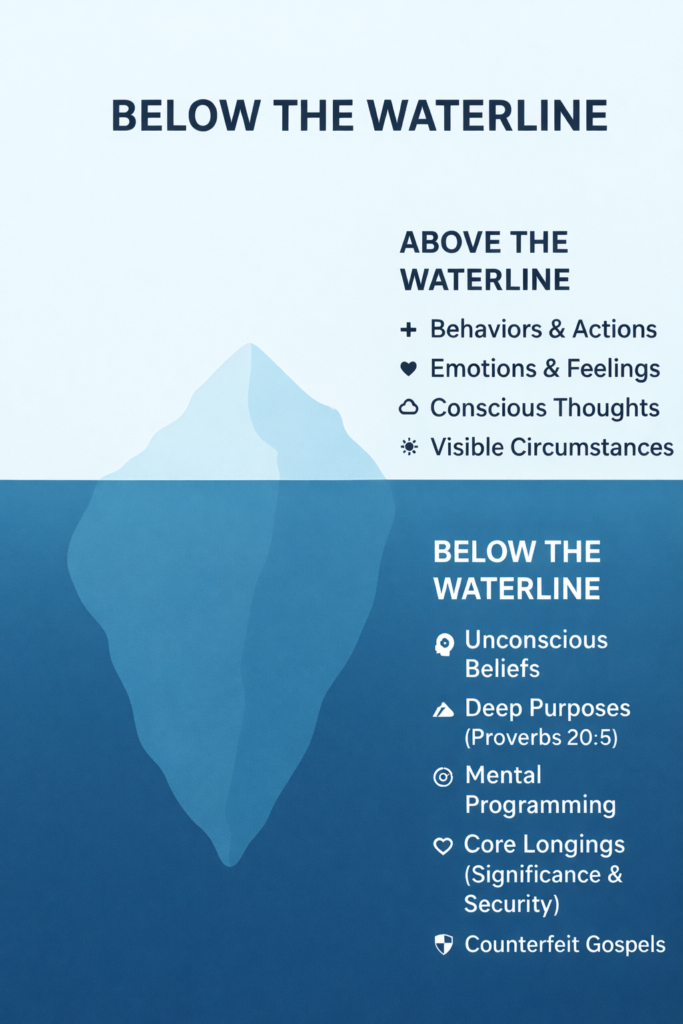
The Iceberg Principle:
Like an iceberg, only 10% of what drives us is visible. The remaining 90% lies below the waterline:
- Above the waterline: Behaviors, emotions, conscious thoughts, circumstances
- Below the waterline: Unconscious beliefs, deep purposes (Proverbs 20:5), mental programming, core longings (significance & security), counterfeit gospels
Why This Matters:
Surface-level Bible study asks: What does this mean? What should I do? These are good questions, but incomplete. If we stop here, we miss Scripture’s primary target.
Below-the-waterline study asks:
- What unconscious beliefs does this passage expose?
- What counterfeit gospels (false sources of life) appear here?
- What does this reveal about what truly drives me?
- How does the gospel address these deep purposes?
Theological Foundation:
For unbelievers: The heart itself is corrupted (heart of stone, Ezekiel 36:26), trusting counterfeit gospels for significance and security.
For believers: The New Covenant gives a completely new heart (Ezekiel 36:26; 2 Corinthians 5:17)—not an improved version of the old heart, but a replacement. Your new heart is fundamentally oriented toward God and truly desires dependence on Him. However, “the flesh”—old programming, accumulated beliefs, and patterns formed when the Sinful Heart ruled—remains and requires progressive renewal. What’s below the waterline for believers is flesh-level counterfeit gospels that contradict what your new heart already knows and desires. Sanctification is the Spirit’s work of aligning your soul (mind, will, emotions, behavior) with your new heart’s direction.
Supporting Scriptures:
- Proverbs 20:5 (deep purposes require drawing out)
- Jeremiah 17:9 (the heart is deceitful)
- Mark 7:21-23 (sin comes from within)
- Hebrews 4:12 (God’s Word penetrates soul and spirit)
- Romans 12:2 (transformation through mind renewal)
- Ezekiel 36:26-27 (new heart and Spirit)
True transformation addresses the whole person—not just behavior modification, but renewed beliefs, redirected desires, and Spirit-empowered dependence on God.
Practical Steps for Studying the Bible
1. Pray Before You Read
Ask the Spirit to open your eyes to see wonderful things in God’s Word (Psalm 119:18). Acknowledge your dependence on Him for understanding. Pray for a humble, teachable heart.
2. Read Whole Books
Instead of jumping around or reading isolated verses, read entire biblical books. Understanding comes from seeing the flow of thought, the development of themes, and the progression of argument.
Start with shorter books: Philippians, Ephesians, 1 John, James, Jonah, Ruth.
Read multiple times: Read through the book several times before diving into detailed study. Each reading reveals new details and connections.
3. Ask Good Questions
As you read, ask:
- What does this passage say about God?
- What does it say about humanity?
- What does it teach about sin, redemption, or salvation?
- What commands or principles are here?
- How does this connect to the surrounding context?
- What is the main point the author is making?
- How does this fit into the Bible’s big story?
4. Use Study Tools (Wisely)
Caution: Use tools to inform your reading, not replace it. Read the text first, form your own observations, then consult resources.
Study Bibles: Provide notes, cross-references, and context. ESV Study Bible and Gospel Transformation Bible are excellent options.
Bible Dictionaries: Explain biblical terms, customs, places, and people.
Cross-References: Show where else the Bible addresses the same topics or uses the same language.
Online Resources: Sites like Bible Gateway, Blue Letter Bible, and BibleProject offer free tools.
5. Trace Themes Through Scripture
Pick a biblical theme (covenant, kingdom, faith, worship, suffering) and trace it through the Bible. See how the theme develops from Genesis to Revelation. This builds biblical literacy and shows the unity of Scripture.
6. Memorize Scripture
Hide God’s Word in your heart (Psalm 119:11). Memorization isn’t just for children—it’s a spiritual discipline that shapes how we think, strengthens us in temptation, and prepares us to encourage others.
Start small (one verse per week) and review regularly. Memorize passages, not just isolated verses, so you internalize the flow of thought.
7. Study in Community
Discuss what you’re learning with other believers. Join a Bible study. Ask your pastor questions. The Spirit works through the body of Christ to illumine Scripture (Ephesians 4:11-16).
Different perspectives and insights help us see what we might miss on our own. Studying in community also provides accountability and encouragement.
8. Use the “Reading Below the Waterline” Method
While the foundational principles above help you understand what Scripture means, this method helps you experience transformation through Scripture by addressing what operates beneath conscious awareness.
Prayer Before You Begin:
“Father, Your Word is living and active, penetrating to the division of soul and spirit (Hebrews 4:12). Open my eyes to see what operates below the waterline. Help me not just understand this passage, but treasure Christ through it. Do in me what I cannot do for myself. Transform me from the inside out by the power of Your Spirit. Amen.”
The Four Steps:
Step 1: Ask the Heart Question – Move beyond “What does this mean?” to “What does this reveal below the waterline?”
Look for:
- What unconscious beliefs drive the behavior Scripture addresses?
- What counterfeit gospels (false sources of significance and security) appear in the passage?
- What is the flesh trusting instead of God?
For believers: Your new heart already knows Christ is better. This step exposes the flesh’s contradictory programming.
Step 2: Expose the Counterfeit Gospel – Identify what people in the passage are trusting instead of God, then ask: “What is my flesh’s version of this counterfeit?”
Use the three-part anatomy to expose counterfeits:
- Counterfeit – What false source of life is the flesh pursuing?
- Longing – What legitimate desire is this counterfeit attempting (poorly) to satisfy?
- Lie – What false belief makes this counterfeit seem viable?
Apply the disenchantment principle: God graciously allows counterfeits to fail. Don’t waste your disappointment—use it to turn toward Christ. When idols break, that’s grace exposing their futility.
Step 3: Embrace the Gospel – Connect the passage to Christ and gospel truth.
Move from intellectual knowledge to experiential treasure-discovery:
- Don’t just affirm “Christ is better”—ask how He satisfies what the counterfeit promised but couldn’t deliver
- Use treasure language: How is Christ supremely satisfying, not just superior?
- Apply the awakening framework: Even if you’re familiar with this truth, ask God to give you fresh eyes to see Christ’s beauty again
- Move from “I know about Christ” to “I see and taste that Christ is good”
Your new heart already treasures Christ—this step helps your thinking align with what your heart knows.
Step 4: Apply Below the Waterline – Address three interconnected levels:
- Belief – What false belief does the flesh hold? What gospel truth replaces that lie? How do I meditate on this truth until my thinking aligns with my new heart’s knowledge?
- Desire – What counterfeit gospel is my flesh trusting? How has the gospel exposed its futility? How do I actively turn from the counterfeit toward Christ as superior treasure—the One my new heart already loves?
- Feast vs. starve: Don’t just turn away—turn toward. Starve the counterfeit; feast on Christ.
- Desire transformation: From forcing obedience to discovering delight
- Dependence – Where is the flesh living independently? What does it look like to practice dependence on God in specific situations? How do I cooperate with the Spirit rather than self-improve?
Why this works:
Traditional application targets behavior. Below-the-waterline application targets beliefs, desires, and dependence—bringing your soul into alignment with your new heart’s direction. This produces sustainable, Spirit-empowered transformation rather than temporary willpower-driven change.
Spirit-Dependence: This method helps you cooperate with what the Spirit is already doing—aligning your conscious choices with your new heart’s true direction. The power is His, not yours. And that’s exactly why it works.
Learn more:
For a complete guide with detailed examples and practice exercises, see our guide: Reading Below the Waterline
Our Bible Studies
At The Gospel Today, we’re committed to helping you develop biblical literacy through careful exposition of Scripture. Our verse-by-verse studies model faithful interpretation and application.
Coming Soon!
Keep Growing
Biblical literacy is a lifelong pursuit. None of us will master Scripture in this life—but we can grow in our understanding year by year, becoming more competent readers and faithful disciples.
The time you invest in learning to study God’s Word will pay dividends for the rest of your life. Don’t be discouraged by what you don’t understand. Celebrate what you’re learning. Ask questions. Stay curious. Keep reading.
God’s Word is living and active (Hebrews 4:12). As you study it faithfully, the Spirit will use it to transform you from the inside out.