
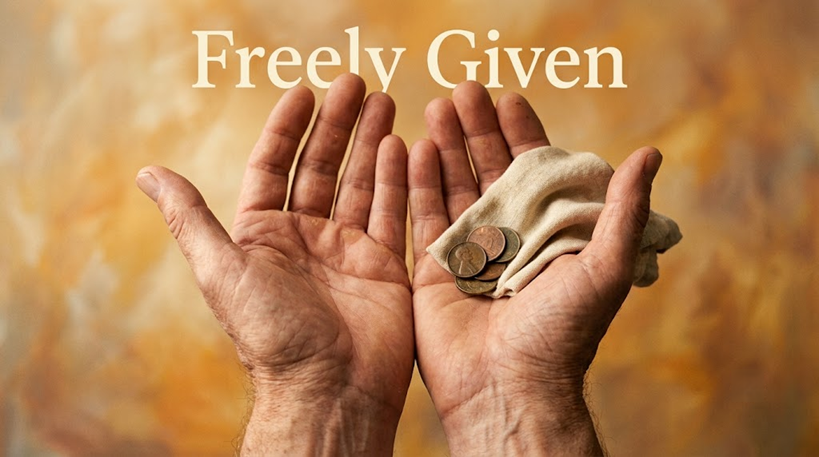
[This is Part 1 of “Freely Given: Recovering a Gospel Vision of Generosity,” a series examining what Scripture teaches about Christian generosity.]
When the Question Shapes the Answer
Most conversations about Christian giving and grace never quite get where they need to go — not for lack of sincerity or care for what Scripture says. The problem is that they almost always begin with the wrong question.
The question is familiar: How much do I have to give? You’ve heard it in sermons, worked it into a budget, felt it in your conscience during a stewardship appeal. It presents as responsible. It sounds like faithfulness. But something about it doesn’t settle, and this series is going to examine why.
The problem isn’t that the question is irresponsible. The problem is that it is a law question. Law questions produce law answers — a threshold, a minimum, a line between the faithful and the unfaithful giver. The New Testament invites us into a different kind of world.
How the Tithe Became the Standard
Few topics in evangelical Christianity are as settled in practice — and as unsettled in Scripture — as the tithe. Ask most churchgoing believers what faithful giving looks like, and they’ll say: ten percent, to the local church, as the starting point. That framework is concrete. It gives people a number and a measure by which to evaluate themselves. And it is largely absent from the New Testament.
It’s a textual observation rather than a polemical one, and we’ll examine it carefully in our next post. The word “tithe” (in both noun and verb form) appears only a handful of times in the New Testament. In Hebrews 7, the tithe functions as part of a Christological argument about the superiority of Christ’s priesthood over the Levitical order — not as instruction about what Christians should give. In the Gospels, Jesus references the tithe twice: rebuking Pharisees who tithe down to their herb gardens while neglecting justice and mercy, and using a self-righteous tithe-giver as a cautionary parable. Neither passage tells the new covenant church what to give.
What’s more striking is who doesn’t use the word at all: the apostle Paul. Paul wrote the most sustained teaching on Christian generosity in the entire New Testament. He organized a major collection from Gentile churches to support suffering believers in Jerusalem. He addressed financial support for gospel workers and giving patterns in multiple congregations. In all of it, he never once reaches for the tithe as his frame. When Paul explains the theological basis of Christian giving, the word he uses is not law but grace.
Christian Giving and Grace: Paul’s Governing Category
In 2 Corinthians 8:7, Paul is urging the church at Corinth to follow through on a financial commitment they had made to support Jerusalem believers. He could have appealed to duty, obligation, or the tithe as precedent. Instead he writes:
“But as you excel in everything — in faith, in speech, in knowledge, in all earnestness, and in our love for you — see that you excel in this act of grace also.” (2 Corinthians 8:7, ESV)
“This act of grace” translates a single Greek word: charis — the same word used throughout the New Testament for the grace of God in salvation.1 Paul is not calling the Corinthians’ giving a discipline they should develop or a debt they owe. He’s calling it a grace — something God works in people, not something people generate through effort or obligation.
This word choice matters because it shifts the question. If giving is governed by law, the question is: have I met the minimum? If giving is a grace God works in us, the question changes: what has God been doing in me? The questions are different, and they produce different lives.
The theological anchor Paul drops eight verses later makes the ground explicit. Verse 9: “For you know the grace of our Lord Jesus Christ, that though he was rich, yet for your sake he became poor, so that you by his poverty might become rich.” The cross isn’t a motivation Paul attaches to the argument at the end. It is the argument. Christ’s own self-giving is the source from which Christian generosity flows — the ground that makes grace-based generosity possible, and the pattern it takes the shape of.
A Different Kind of Arithmetic
Jesus approaches the same question from a different angle in Luke 21:1-4. He watches wealthy people dropping their offerings into the temple treasury, then watches a widow deposit two small copper coins.
“And he said, ‘Truly, I tell you, this poor widow has put in more than all of them. For they all contributed out of their abundance, but she out of her poverty put in all she had to live on.’” (Luke 21:3-4, ESV)
The widow’s offering is often read as a lesson in sacrificial giving, and that reading isn’t wrong. But what Jesus is actually exposing is something beneath the act itself — the posture behind it, and what that posture reveals. The wealthy gave from their surplus: what remained after their security was fully assured. The widow gave from poverty, which means she gave without a safety net. The amount was negligible by any financial measure. What Jesus notices is not the amount. It’s what the giving reveals about where her confidence actually resided.
Jesus doesn’t establish a percentage here. He doesn’t tell us the widow gave 100% and therefore we should give 50%. He redirects our attention from the mechanics of the transaction to the theology of the giver — the thing the transaction reveals about trust, security, and what she was actually holding onto. That’s a more searching question than the tithe raises, and a more freeing one when the answer is grounded in the gospel.
What This Series Will Examine
We’ve started where most giving conversations don’t: with the question itself, and with the claim that the question most Christians have learned to ask is a law question, while the New Testament answers a different one.
The rest of this series does the constructive work. In the next post, “What the Law Could Never Teach”, we examine the tithe directly — what it is in its Old Testament context, what the New Testament actually does with it, and what conclusions we should honestly draw. The aim isn’t to dismiss the tithe but to locate it correctly.
In the third post, “The Grace of Giving”, we spend sustained time in 2 Corinthians 8-9, the richest treatment of Christian generosity in all of Scripture. Paul’s theology of giving is grace-based from beginning to end, and understanding it changes how we think about everything from how much we give to what generous giving is supposed to feel like from the inside.
In the final post, “Generosity in Practice”, we turn to the practical question this series has been building toward: where should we give? The New Testament addresses this more directly than many realize — to the local church, to gospel workers, to those in need — and offers a framework for navigating giving decisions that is not another formula.
The series title comes from Matthew 10:8: “Freely you have received; freely give.” That sentence is less a command than a description. When grace has genuinely done its work, giving freely is what follows.
Closing Reflection
The invitation this series extends is not to feel worse about how much you give or to add another obligation to a crowded conscience. It’s to examine what is actually governing your generosity — whether the questions you bring to your giving are law questions or grace questions.
There is a version of generous giving shaped by law: a percentage met, a threshold cleared. And there is a version shaped by grace: a response to what has already been received, flowing from freedom rather than from a need to perform or comply. The Macedonian church Paul holds up as a model in 2 Corinthians 8 gave “beyond their means” and called it a privilege (2 Cor 8:3-4). That is what giving looks like when grace — and not law — is governing your generosity.
The difference between those two versions is not the amount — it is what motivates the giving.
Application Points
- Examine the fundamental question you actually bring to giving. Before this series ends, sit honestly with the question that has most governed your giving decisions. Is it “how much must I give?” — or something else? The governing question reveals whether law or grace is doing the motivating work in your generosity.
- Read 2 Corinthians 8-9 this week. Don’t wait for the series to get there. Read those two chapters slowly, noting every time Paul uses grace language and every time he appeals to what Christ has done rather than what the Corinthians owe. Let Paul’s vocabulary settle in before we examine it together.
- Hold your current giving practice with an open hand — in both directions. Whatever your current practice, this series isn’t asking you to abandon it. It is asking whether what you give represents a law you’re meeting or a grace you’re expressing. The distinction matters more than the percentage.
- Let the widow’s offering ask its question. The scene in Luke 21 is less a lesson about giving than a question about trust. Sit with what Jesus observes and ask honestly what your current giving reveals about where your security actually rests. Not to produce guilt — to open the conversation with the Lord.
- Consider reading this series with someone. The New Testament’s giving texts are consistently communal — the Macedonian church, the Jerusalem collection, the Philippian partnership with Paul. Consider inviting a spouse, a friend, or a small group to work through these posts together.
Reflection Questions
- What question has most governed your approach to giving — and where did you learn to ask it?
- When you consider the widow at the treasury, what does your current giving reveal about where your security actually rests?
- The Greek word charis appears six times in 2 Corinthians 8-9 in connection with the collection: 8:1, 8:4, 8:6, 8:7, 8:9, and 9:8. This density of grace language is deliberate and theologically significant. Paul is establishing that Christian generosity belongs to the same category as God’s saving work in Christ, not to the category of duty or legal obligation. ↩︎